In the hallowed halls of the British Museum, a 3,000-year-old relief from the Northwest Palace collection has become the talk of the town—and the subject of a full-blown social media circus. Carved into limestone, the image of an Assyrian warrior gliding through stylized waves while apparently inhaling from a tube sent the internet into a tailspin, with armchair archaeologists declaring it proof that scuba diving predates Jacques Cousteau by millennia. But as with many viral sensations, the devil is in the details—and in this case, those details reveal a far more impressive story of human ingenuity than any ancient underwater adventure.
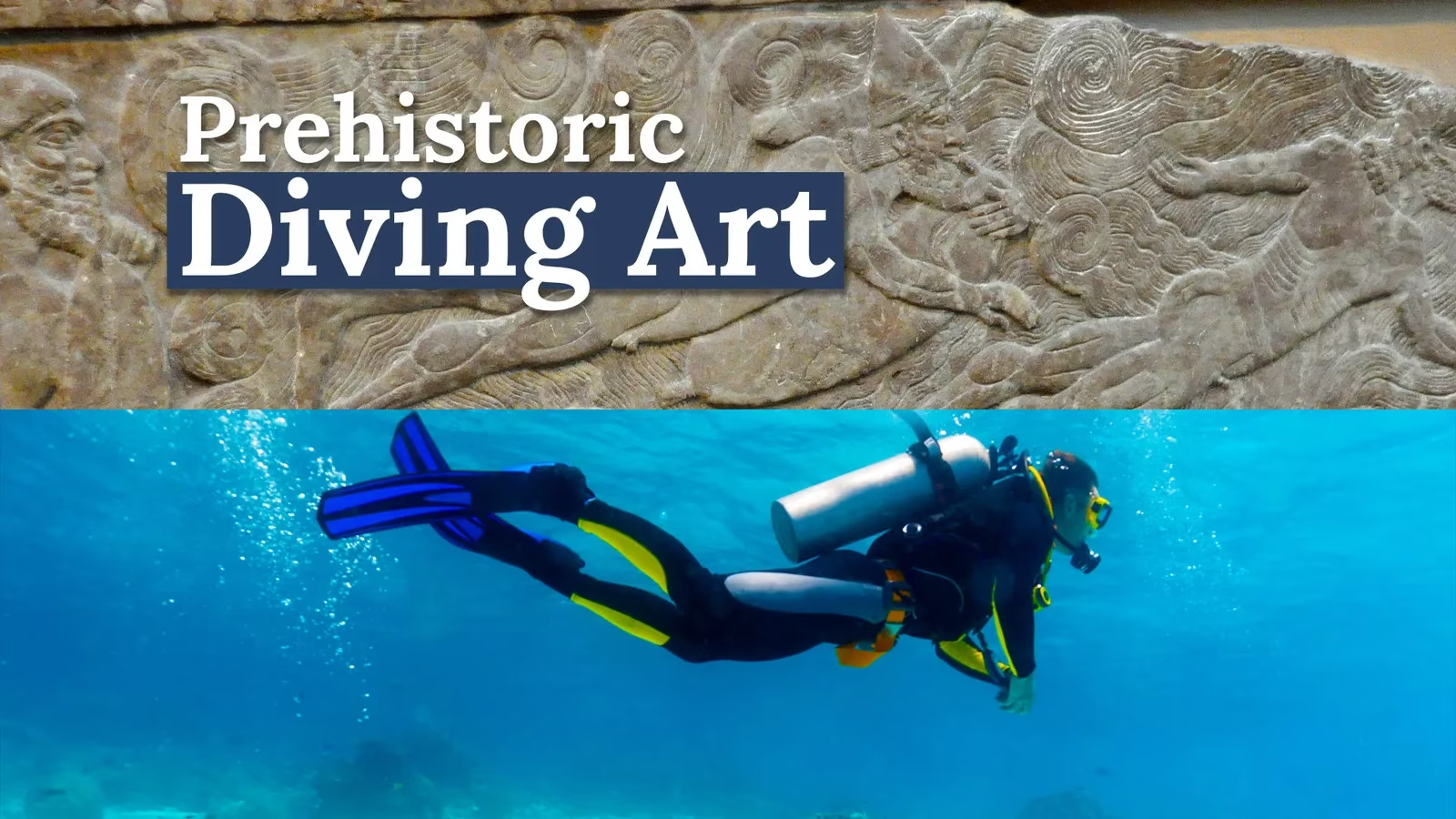
The narrative of “ancient scuba gear” took off like wildfire, spreading across platforms where nuance often gets thrown out the window. To the casual observer, the carving does bear an uncanny resemblance to a diver breathing from an air tank, and that superficial similarity was enough to set off a game of telephone that turned a practical military tool into a prehistoric rebreather. The buzz escalated so quickly that even reputable outlets had to step in to separate wheat from chaff. But the old saying holds true: when you hear hoofbeats, think horses, not zebras—and the real explanation, while lacking the Hollywood flair, is a textbook example of ancient engineering savvy.
Setting the Record Straight: What the Relief Actually Depicts
Housed in Room B, Panel 11 (catalog number WA124541) of the British Museum’s Northwest Palace collection, the artifact portrays a warrior using an inflated goatskin bag as a buoyancy device, not an oxygen tank. The Assyrians, who dominated Mesopotamia between the 9th and 7th centuries BCE, were masters of military logistics, and they faced a perennial challenge: the mighty Tigris and Euphrates rivers. Crossing these waterways silently and keeping weapons dry was a tactical necessity, and the solution they cooked up was as clever as it was simple. By inflating animal skins and tying them around their waists, soldiers could float across rivers under cover of darkness, blending into the currents and catching enemy forces completely off guard. No breathing apparatus required—just a lungful of air and a healthy dose of nerve.
The repeated image of the warrior calm amidst waves did not signify an early fascination with the deep blue; rather, it celebrated a feat of survival and stealth. It’s worth noting that the Assyrians were not the only ancient people to use animal skins for flotation—evidence from other riverine civilizations echoes the same technique—but the British Museum relief immortalizes it with an artistic flair that still captures modern imaginations.
Military Ingenuity That Changed the Game
Far from being a curiosity for divers, this artifact underscores why the Assyrian Empire became a juggernaut. Their military dominance was not solely built on brute force but on outthinking opponents. The flotation system turned rivers from obstacles into highways for surprise attacks and rapid supply movements. Imagine a squadron of warriors drifting silently downstream, their weapons bundled and dry, emerging behind enemy lines with not a single alarm raised. That kind of tactical edge was worth its weight in gold—and it contributed to the empire’s ability to control vast territories across modern-day Iraq, Syria, and beyond.
In a nutshell, the relief is a testament to problem-solving that predates modern engineering by several millennia. The goatskin bags were readily available, easily repaired, and, when deflated, could be stowed without hogging precious cargo space. It’s the sort of low-tech, high-impact innovation that folks in Silicon Valley might call “elegant” today—proving that ancient minds were every bit as sharp as our own.
The Social Media Echo Chamber and Historical Truth
The saga of the “Assyrian scuba diver” is a classic example of how online platforms can turn a molehill of misunderstanding into a mountain of misinformation. The initial post that fired up the rumor mill likely came from a place of genuine wonder—and there’s nothing wrong with that—but before you could say “fact-check,” the tale had a life of its own. New layers were added with each retweet: not just a breathing tube, but goggles, flippers, and even an entire underwater training program for Assyrian commandos. It was, to borrow a phrase, a classic case of the tail wagging the dog.
Yet, the truth is no less exciting. The fact that a 3,000-year-old civilization devised such an effective method to navigate treacherous rivers is mind-boggling in its own right. It speaks to a deep understanding of materials, physics, and human physiology—knowledge that was passed down through generations and helped forge one of history’s first true empires. So, while the internet may have jumped the gun, the real story invites us to appreciate the quiet genius that often hides in plain sight in museum galleries.
Appreciating the Artifact Without the Hype
Visitors to the British Museum in 2026 can still view this remarkable piece and draw their own conclusions—ideally after reading the exhibit notes rather than relying on a social media snippet. The relief remains a star attraction in the Northwest Palace collection, a conversation starter about how we interpret ancient imagery. And if you find yourself chuckling at the scuba gear meme, you’re not alone; even curators admit the carving’s setup is deliciously ambiguous at first glance. But taking the time to peel back the layers reveals a richer narrative: one where human creativity didn’t need modern technology to achieve the extraordinary.
Ultimately, the Assyrian flotation device isn’t a letdown—it’s a reminder that our ancestors were far more resourceful than we often give them credit for. They didn’t dive beneath the waves, but they did master the currents of the Tigris, and that mastery changed the course of history. So, the next time a sensational claim about ancient marvels makes the rounds, it might be worth taking a beat, diving into the scholarship, and discovering the authentic innovation that has been staring us in the face for three millennia.
Comments